
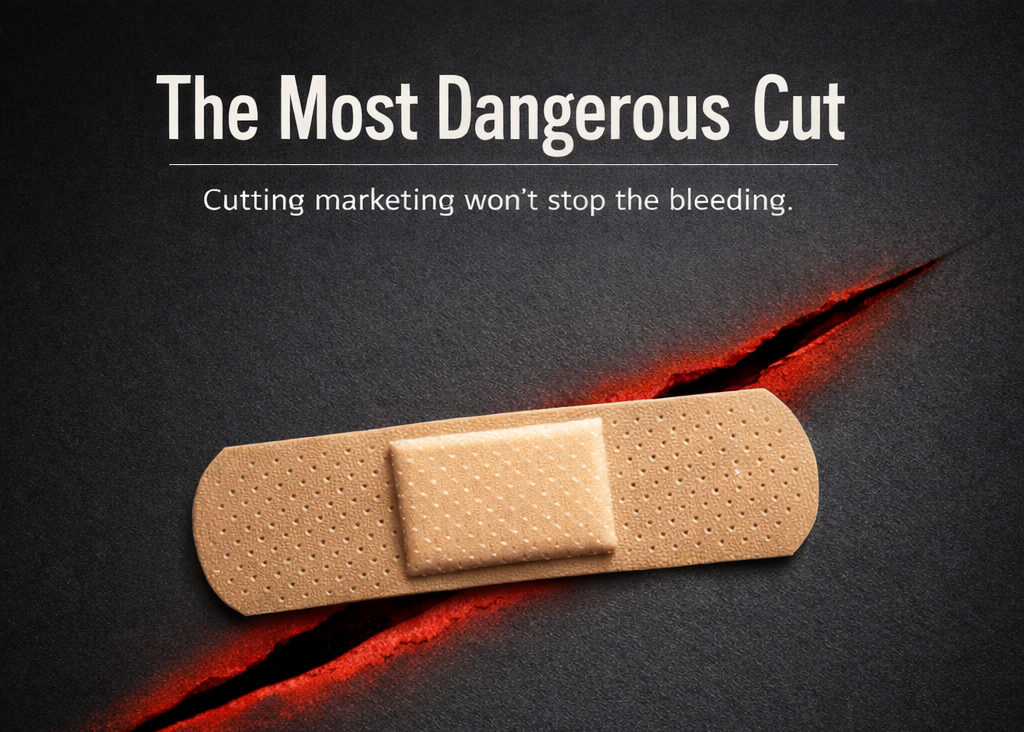
The Most Dangerous Cut: Cutting Marketing Won’t Stop the Bleeding
It’s a new year. You had a rough fourth quarter. Sales dipped. A big client walked. Something went wrong, maybe a few things did. Now you’re in panic mode.
Spreadsheets are open. Forecasts are being revised. Conversations get quieter. And somewhere in the room, someone says the words that feel responsible in the moment, we need to stop the bleeding.
That instinct isn’t wrong. When revenue drops unexpectedly, leaders should protect cash flow and stabilize the business. Where we’ve seen companies get into trouble is when panic-driven triage quietly turns into long-term strategy.
As we enter our 40th year at HCP Associates, we’ve seen this movie more than once. Sometimes the cause is too many eggs in one basket. Sometimes diversification started too late. Sometimes a leadership transition didn’t go as planned. Sometimes it’s simply timing and market forces colliding. None of that makes a company weak. It makes it human.
Here’s the question we always come back to. If revenue drops, would you fire your best salesperson?
Of course not.
And by the way, in most organizations, the best salesperson should be the CEO.
Yet that’s effectively what happens when marketing is the first thing cut after losing a major client.
Marketing isn’t just advertising. It’s the umbrella that includes research, strategy, and public relations. It’s how you understand what changed, how your market is behaving, and how your story needs to evolve. When marketing is cut to save money, it isn’t stopping the bleeding. It’s removing the very system designed to diagnose the problem and replace the revenue that was just lost.
We saw this clearly during COVID. We worked with companies that lost as much as 40 to 50 percent of their revenue almost overnight. The ones that recovered fastest didn’t go silent. They redirected direct marketing dollars into research, listening, and strategic recalibration. They used that downtime to understand new buyer behavior, stress-test assumptions, and sharpen their positioning. When the market reopened, they returned with clarity, confidence, and momentum, and in many cases, with a vengeance.
Others used that same period to do something just as valuable. They brought leadership teams together for focused, disciplined strategic planning sessions, often moderated by a third-party professional. Not endless meetings, but structured work designed to align leadership, challenge assumptions, and set a clear path forward. Marketing funded insight, not noise.
We’ve also watched what happens when companies do the opposite. Marketing momentum collapses. Brand awareness fades. Pipelines thin. Competitors fill the vacuum. By the time leadership feels the impact, six to nine months have already passed. Markets don’t punish companies for losing clients. They punish companies that look like they’re retreating.
There’s also a misconception that disciplined marketing is something only large organizations can afford. In our experience, small and mid-sized businesses need it even more. Healthy organizations should plan to invest roughly two to five percent of gross revenue in marketing. That’s not aggressive spending. It’s responsible planning. Large companies don’t disappear when something breaks. They reallocate, tighten focus, and protect visibility while they fix what needs fixing.
Stopping the bleeding should mean cutting waste and inefficiency, not cutting your narrative, your presence, or your voice in the market.
The most dangerous period after losing a major client isn’t the immediate revenue dip. It’s the moment you stop showing up.
After 40 years in this business, one thing is clear. If you find yourself in that moment, don’t just ask what can be cut. Ask what must be protected, researched, and rethought while you stabilize and rebuild. That question usually changes the outcome.